
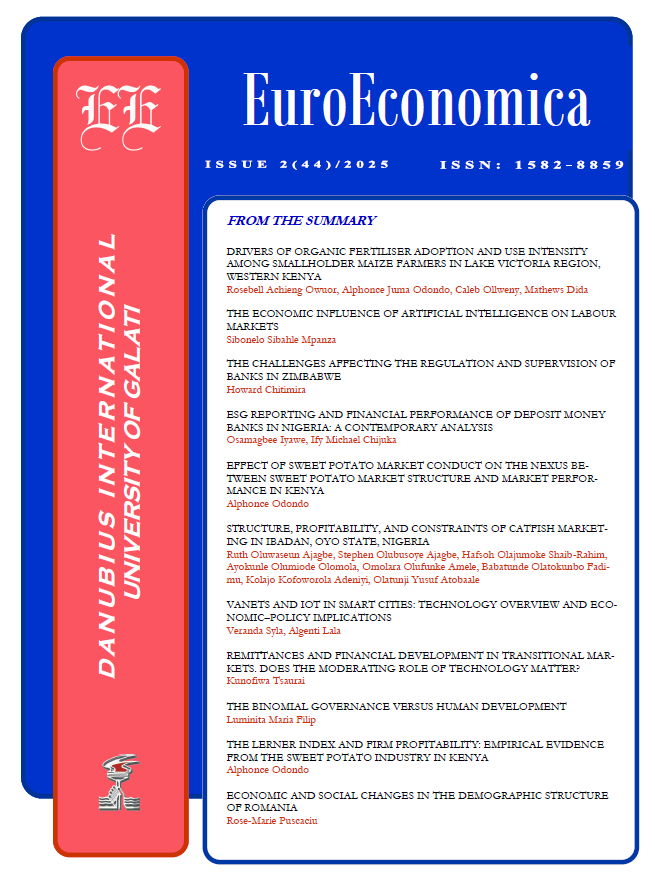
Remittances and Financial Development in Transitional Markets. Does the Moderating Role of Technology Matter?
Keywords:
Technology; Remittances; Panel Data; Transitional Markets; Financial SectorAbstract
Objectives: This study explored the influence of remittance on financial development in transitional markets. It examined if financial development was influenced by the complementarity between remittance and technology in transitional markets. In other words, it investigates whether technology advancement channel is essential in ensuring that remittances are directed towards financial development. Prior Work: What triggered the study is that existing literature produced inconclusive, mixed and divergent results. Approach: The study employed the Hansen (2000) threshold regression model and the panel corrected standard errors approach. Results: The results indicate that remittances on their own negatively influence financial development but at the very most positively influence financial development in a non-significant manner. Technology had a non-significant enhancing impact on financial development. The complementarity between remittance and technology significantly improved financial development. Implications: Transitional markets must implement policies geared at enhancing remittance inflow and technology advancement to deepen the financial sector. Further studies on the subject matter need to focus on examining more than one threshold levels of remittances above which significant financial development occurs. Value: The study indicated that technology development enhances remittances’ ability to improve financial development in transitional markets.
References
Adekunle, I. A., Tella, S. A., Subair, K., & Adegboyega, S. B. (2020). Remittances and financial development in Africa. European Xtramile Centre of African Studies WP/20/081.
Afridi, M. A., Khan, I., Rahman, H. U., & Khan, M. R. (2024). Remittances as a driver of economic growth: The moderating impact of financial development in developing economies. Journal of Economic and Administrative Sciences, December (2024), 1-21.
Alhassan, U., Maswana, J., & Inaba, K. (2025). Leveraging remittances for entrepreneurship: The role of financial development in developing economies. Journal of Knowledge Economy, 2-40.
Anghel, M., Nita, G., & Badiu, A. (2017). Impact of remittances on financial development and economic growth. Romanian Statistical Review, 1(2017), 106-112.
Anwar, A., & Afesorgbor, S. K. (2021). The effect of remittances on financial development: Evidence from a meta-analysis.
Azizi, S. (2019). Impacts of remittances on financial development. Journal of Economic Studies, 47(3), 467-477.
Armendáriz de Aghion, B., & Murdoch, J. (2005). The Economics of Microfinance. Cambridge: The MIT Press.
Baltagi, B. H., Demitriades, P. O., & Law, S. H. (2009). Financial development, openness and institutions: Evidence from panel data. Journal of Development Economics, 89(2), 285-296.
Bandura, W. N., Zivanomoyo, J., & Tsaurai, K. (2019). Remittances, financial development and economic growth: A case of SADC countries. Acta Universitatis Danubius OEconomica, 15(4), 67-82.
Batool, Z., Haroon, M., Ali, S., & Ahmad, R. (2022). Remittances and economic growth: Exploring the role of financial development. IRASD Journal of Management, 4(1), 127-134.
Biyase, M., & Naidoo, Y. (2023). The symmetric and asymmetric effect of remittances on financial development: Evidence from South Africa. International Journal of Financial Studies, 11(26), 1-17.
Chiwira, O., & Murindagomo, T. (2024). Examining the relationship between remittances and financial development in Zimbabwe. International Journal of Research in Business and Social Science, 13(10), 181-188.
Cornelius, W. (1990), Labour migration to the U.S.: development, outcomes, and alternatives in Mexican sending communities. Report of the Commission for the Study of International Migration and Cooperative Economic Development. Washington, D.C.: Government Printing Office.
Forhad, R. J., & Alam, G. M. (2025). The impact of remittance on financial management in the recipient: A comparison between highly-and low-skilled migrants. Migration and Development, 14(1), 62-78.
Gupta, S., Pattillo, C., & Wagh, S. (2007). Impact of remittances on poverty and financial development in Sub-Saharan Africa. International Monetary Fund Working Paper Series Number WP/07/38.
Hamma, I. E. (2016). Migrant remittances and economic growth: The role of financial development and institutional quality, Economie et Statistique, 2018(503-504), 123-142.
Hamma, I. E. (2018). How catalytic is digital technology in the nexus between migrants’ remittance and financial development in Sub Saharan African countries. Economies, 11(74), 1-12.
Hansen, B. E. (2000). Sample splitting and threshold estimation. Econometrica, 68(3), 575-603.
Jemiluyi, O. O., & Jeke, L. (2023). How catalytic is digital technology in the nexus between migrants’ remittance and financial development in Sub Saharan African countries. Economies, 11(74), 1-12.
Karikari, N. K., Mensah, S., & Harvey, S. K. (2016). Do remittances promote financial development in Africa? SpringerPlus, 5(2016), 1-21.
Keho, Y. (2016). Non-linear effect of remittances on banking sector development: Panel evidence from developing countries. Theoretical Economics Letters, 6(5), 1096-1104.
Keho, Y. (2020). Impact of remittances on financial development: Revisiting the evidence for ECOWAS countries. Theoretical Economic Letters, 10(1), 169-179.
Keho, Y. (2024). Impact of remittances on domestic investment in Western African countries: The mediating role of financial development. SN Business and Economics, 4(20), 1-27.
Liu, J., Li, X., & Wang, S. (2020). What have we learnt from 10 years of fintech research? A scientometric analysis. Forecasting Technological and Social Change, 155(June), 1-11.
Li, X., & Liu, X. (2005). Foreign direct investment and economic growth: An increasingly endogenous relationship. World Development, 33(3), 393-407.
Mustapha-Jaji, O. K., & Adesina-Uthman, G. A. (2023). The impact of international remittances on financial development in Nigeria: 1981-2021. Economic Development, Technological Change and Growth, 19(1), 130-146.
Majeed, A., Jiang, P., Ahmad, M., Khan, M. A., & Olah, J. (2021). The impact of foreign direct investment on financial development: New evidence from panel co-integration and causality analysis. Journal of Competitiveness, 13(1), 95-112.
Mhlanga, D. (2020). Industry 4.0 in finance: The impact of artificial intelligence (AI) on digital financial inclusion. International Journal of Financial Studies, 8(45), 1-14.
Misati, R. N., Kamau, A., & Nassir, H. (2019). Do migrant remittances matter for financial development in Kenya? Financial Innovation, 5(31), 1-25.
Motelle, S. I. (2011). The role of remittances in financial development in Lesotho: Evidence from alternative measures of financial development. Journal of Development and Agricultural Economics, 3(6), 241-251.
Nadabo, Y. S. (2023). Revisiting the nexus between remittances and financial sector development in Nigeria. Economic Journal of Emerging Markets, 15(2), 115-128.
Odhiambo, N. M., & Musakwa, M. T. (2024). Remittance inflows and financial development in Sub-Saharan African countries: Does governance matter? Heliyon, 10(2024), 1-8.
Olayungbo, D. O., & Quadri, A. (2019). Remittances, financial development and economic growth in Sub-Saharan African countries: Evidence from a PMG-ARDL approach. Financial Innovation, 5(9), 1-25.
Orozco, M., & Fedewa, R. (2005). Leveraging Efforts on Remittances and Financial Intermediation. Washington D.C.: Inter-American Development Bank.
Pesaran, M. H. (2021). General diagnostic tests for cross-sectional dependency in panels. Empirical Economics, 60(2021), 13-50.
Prempeh, K. B. (2023). The link between remittance inflows and financial development in Ghana: Substitutes or complements? Cogent Economics and Finance, 11(2), 1-17.
Romer, P. (1986). Increasing returns and long run economic growth. Journal of Political Economy, 94(5), 1002-1037.
Robinson, J. (1952). The Generalisation of the General Theory. In the rate of interest and other Essays. London: MacMillan.
Sharaf, M. F., & Shahen, A. M. (2022). The threshold impact of remittances on financial development: New evidence from Egypt. ERF Working Paper Series Number 1545.
Sobiech, I. (2019). Remittances, finance and growth: Does financial development foster the impact of remittances on economic growth, World Development, 113(January), 44-59.
Svaleryd, H., & Vlachos, J. (2002). Markets for risk and openness to trade: How are they related? Journal of International Economics, 57(2), 369-395.
Tchekoumi, L. B., & Nya, P. D. (2023). Remittances and economic growth: What lessons for CEMAC zone? Cogent Economics and Finance, 11(1), 1-14.
Downloads
Published
Issue
Section
License
Copyright (c) 2025 Kunofiwa Tsaurai

This work is licensed under a Creative Commons Attribution-NonCommercial 4.0 International License.
The author fully assumes the content originality and the holograph signature makes him responsible in case of trial.