
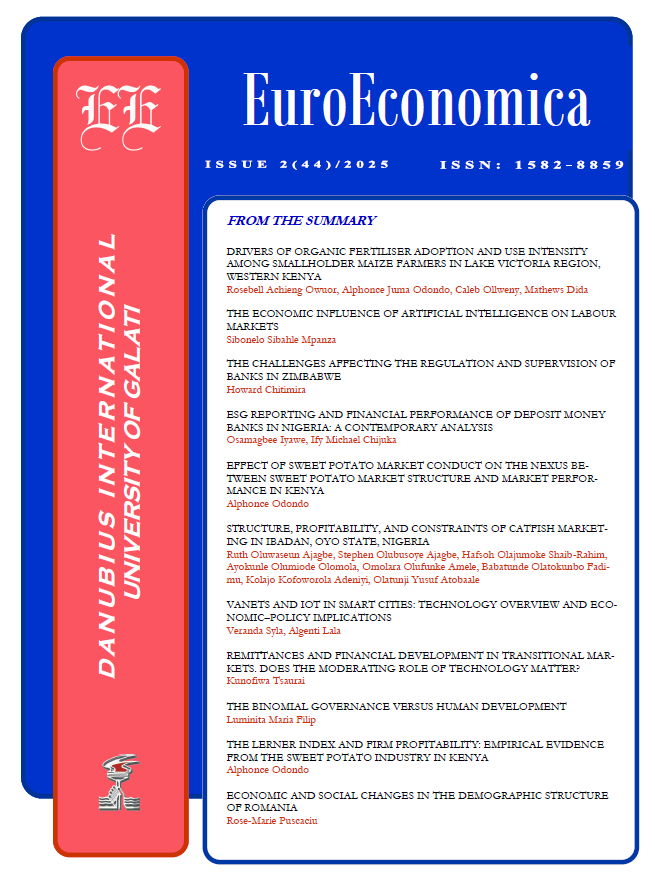
The Economic Influence of Artificial Intelligence on Labour Markets
Keywords:
Artificial Intelligence, Social costs, tech-driven skillsAbstract
Artificial intelligence (AI) is disrupting global labour markets, providing both opportunities and challenges. Although AI offers various opportunities in the labour market, such as automating routine tasks, improving productivity, and creating new jobs, its utilization also poses threats and challenges, including worker displacement and exacerbating inequality. Hence, this article explores the economic impact of AI within the context of employment, wages, and skills, while simultaneously focusing on the opportunities brought by AI, such as innovation in the labour markets. The study follows a mixed-method approach, combining econometric analysis of employment data across OECD countries, case study analysis of industries adopting AI, such as manufacturing and healthcare. In the automated sectors, findings reveal that the integration of AI into the production process has increased productivity by over 15%, creating new job opportunities in AI-driven fields; however, job displacement increased significantly as a result, particularly for low-skilled workers, while wage inequality increased by 8%. This study proposes a framework for balancing innovation brought by AI with social costs, putting more emphasis on workers to acquire tech-driven skills for economic relevance and policymakers to ensure inclusivity. The study contributes significantly to the academic discourse by addressing policy gaps and measuring AI’s labour market effects. Practically, the study recommends investment in tech-driven skills, universal basic income (UBI) pilots, and development of AI governance frameworks.
References
Acemoglu, D. (2002). Technical change, inequality, and the labor market. Journal of Economic Literature, 40(1), 7-72.
Acemoglu, D., & Restrepo, P. (2018). Artificial intelligence, automation, and work. In The economics of artificial intelligence: An agenda (pp. 197-236). University of Chicago Press.
Aghion, P., Jones, B. F., & Jones, C. I. (2017). Artificial intelligence and economic growth.
Arntz, M., Gregory, T., & Zierahn, U. (2016). The risk of automation for jobs in OECD countries: A comparative analysis.
Autor, D. H. (2015). Why are there still so many jobs? The history and future of workplace automation. Journal of Economic Perspectives, 29(3), 3-30.
Autor, D. H., Levy, F., & Murnane, R. J. (2003). The skill content of recent technological change: An empirical exploration. The Quarterly Journal of Economics, 118(4), 1279-1333.
Bessen, J. (2019). Automation and jobs: When technology boosts employment. Economic Policy, 34(100), 589-626.
Bhimani, A., & Willcocks, L. (2014). Digitisation,’Big Data’and the transformation of accounting information. Accounting and Business Research, 44(4), 469-490.
Bloom, N., Jones, C. I., Van Reenen, J., & Webb, M. (2020). Are ideas getting harder to find? American Economic Review, 110(4), 1104-1144.
Brynjolfsson, E., & McAfee, A. (2014). The second machine age: Work, progress, and prosperity in a time of brilliant technologies. WW Norton & Company.
Dauth, W., Findeisen, S., Südekum, J., & Woessner, N. (2017). German robots: The impact of industrial robots on workers.
Frey, C. B., & Osborne, M. A. (2017). The future of employment: How susceptible are jobs to computerisation? Technological Forecasting and Social Change, 114, 254-280.
Goos, M., Manning, A., & Salomons, A. (2014). Explaining job polarization: Routine-biased technological change and offshoring. American Economic Review, 104(8), 2509-2526.
Graetz, G., & Michaels, G. (2018). Robots at work. Review of Economics and Statistics, 100(5), 753-768.
Korinek, A., & Stiglitz, J. E. (2018). Artificial intelligence and its implications for income distribution and unemployment. In The economics of artificial intelligence: An agenda (pp. 349-390). University of Chicago Press.
Manyika, J., Lund, S., Chui, M., Bughin, J., Woetzel, J., Batra, P., Ko, R., & Sanghvi, S. (2017). Jobs lost, jobs gained: Workforce transitions in a time of automation. McKinsey Global Institute, 150(1), 1-148.
Nedelkoska, L., & Quintini, G. (2018). Automation, skills use and training (Vol. 202). OECD Publishing Paris.
Spitz-Oener, A. (2006). Technical change, job tasks, and rising educational demands: Looking outside the wage structure. Journal of Labor Economics, 24(2), 235-270.
Downloads
Published
Issue
Section
License
Copyright (c) 2025 Sibonelo Sibahle Mpanza

This work is licensed under a Creative Commons Attribution-NonCommercial 4.0 International License.
The author fully assumes the content originality and the holograph signature makes him responsible in case of trial.